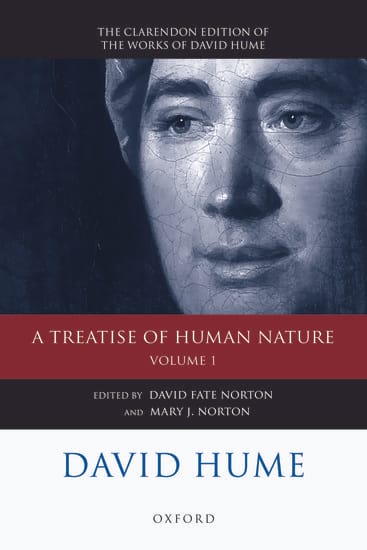

David Hume's Treatise: where knowledge comes from (and why you should doubt it)
The Oxford Clarendon Hume Edition is the definitive scholarly version of Hume's Treatise of Human Nature. David and Mary Norton's edition traces how Hume built his arguments about knowledge, perception, and belief.
The Oxford Clarendon Hume Edition Series, edited by David and Mary Norton, is the standard scholarly edition of A Treatise of Human Nature: Volume 1. If you're going to read Hume seriously, this is the version to use. The Nortons trace textual variants, provide historical context, and explain what Hume was responding to. This post covers Hume's main arguments about causality and necessary connections, the ideas that made him famous and controversial.
Fair warning: this book is hard. Hume's prose is dense, his sentences long, and his ideas counterintuitive. It's not a book you read in an evening. It's one you wrestle with.
Hume wrote in a period where scholarly works were not just vehicles of thought but also artistic expressions, often laden with elaborate linguistic styles.
Hume wrote when scholarly works were also meant to be literary. His sentences have multiple clauses that build arguments layer by layer. For readers used to modern academic writing (or blog posts), the text can feel labyrinthine.
Despite the difficulty, reading the Treatise is worth the effort. Hume's work shaped empiricism and skepticism in ways that still influence philosophy, cognitive science, and physics. Kant famously said Hume woke him from his "dogmatic slumber."
How to read it
Some suggestions for getting through the text:
- Go slow. Hume's arguments build on each other. Missing early concepts makes later sections confusing.
- Use secondary sources. Commentaries can explain what Hume is responding to and simplify complex passages.
- Talk to other people reading it. Study groups and forums help with interpretation.
- Think about how Hume's ideas apply to things you already believe. It makes the philosophy concrete.
What Hume was trying to do
Hume wanted to apply the experimental method to human psychology. He called it the "science of man" and thought it should be the foundation for all other sciences. His approach: observe human behavior and draw conclusions about how thought and emotion actually work, rather than how we think they should work.
The first volume covers what Hume considers the basics of human nature. He divides perceptions into impressions (direct sensory experiences, vivid and immediate) and ideas (faint copies of impressions that we use in thinking). This distinction matters for everything that follows.
Causality and necessary connection
Hume's argument about causality is his most famous and most unsettling. Before Hume, philosophers generally assumed we could perceive necessary connections between causes and effects. Hume said no: our belief in causality comes from habit, not from any logical necessity we can observe.
Our understanding of the universe and our expectations of it are not rooted in reason itself but in our experiences and the habits they engender.
We never actually see cause and effect linked together. What we see is one thing happening, then another thing happening after it. We call this causation because we've seen similar sequences before. The sun rises every morning, so we expect it tomorrow. But that expectation is based on habit, not on any inherent connection between past and future.
This leads to uncomfortable conclusions. If causality is just habit, what's the basis for scientific laws? How certain can we be about anything in the external world? Hume doesn't resolve these questions; he raises them and leaves the reader uncomfortable. For a good counterargument, see Lindley, T. F. (1987). David Hume and Necessary Connections. Philosophy, 62(239), 49-58.
Empiricism as foundation
All of Hume's arguments rest on empiricism: the idea that knowledge comes from sensory experience. He applies this rigorously, arguing that even complex ideas like the self are traceable back to simple sensory impressions.
This made Hume controversial. Some saw his skepticism as nihilistic, a threat to both science and religion. Others found it liberating. Either way, his influence spread through philosophy, psychology, and eventually into the natural sciences.
Hume's questions haven't been answered. They've been argued over for 300 years, and we're still arguing. That's probably the point.
Final thoughts
The Treatise is a challenging book that asks uncomfortable questions about knowledge and certainty. The Oxford Clarendon edition is the right way to read it if you want to understand what Hume actually wrote and why it mattered. But be warned: you might not like the answers. Or rather, the lack of them.