
The Essential Goethe
Johann Wolfgang von Goethe (1749–1832) was one of the greatest writers of the German Romantic period. Matthew Bell is professor of German and comparative literature at King's College London. His books include Goethe’s Naturalistic Anthropology and Melancholia: The Western Malady.
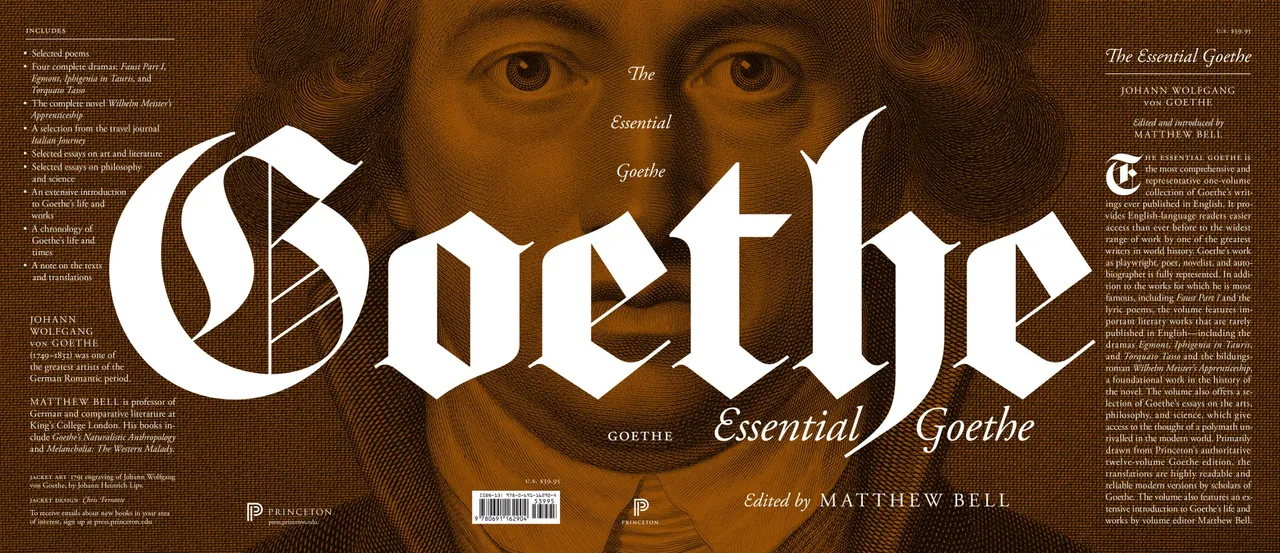
Goethe wrote too much. That's the problem any editor faces when trying to put together a "collected works" of someone who spent sixty years producing plays, novels, poems, scientific treatises, and personal correspondence. Matthew Bell's anthology, The Essential Goethe, tries to solve this by picking the hits and providing enough context to connect them.
What's included
The anthology runs chronologically, starting with the emotional early work and moving into the more philosophical later pieces. You get excerpts from Faust and Egmont, the full Sorrows of Young Werther, chunks of Wilhelm Meister's Apprenticeship, and a selection of poetry. The structure makes sense: you can watch Goethe grow up on the page.
On translation
Translating Goethe is hard. His poetry relies on sounds and rhythms that don't map cleanly to English, and his prose has a density that modern readers find difficult. Bell chose translations that lean toward readability over literal accuracy, which seems like the right call for an introductory anthology. You lose some nuance, but you can actually finish the book.
The commentary and biographical notes do real work here. Goethe lived through the French Revolution, the Napoleonic Wars, and the birth of German nationalism. Without that context, some of his preoccupations make less sense.
What's missing
Fitting Goethe into one volume means leaving things out. His scientific writing on color theory and plant morphology barely appears. Some of the lesser-known plays are gone entirely. If you already know Goethe's work, you'll notice the gaps. But that's the trade-off with any anthology.
For people who've never read Goethe, or who bounced off him in school, this is a reasonable place to start. The selections are well-chosen, the commentary is useful without being intrusive, and the translations are readable. Whether you need to own it depends on how much German literature you're planning to read.